Key Takeaways
- B2B keyword research is no longer about chasing high search volume.It’s about understanding intent, buyer behavior, and decision timelines.
- Unlike B2C, where purchases happen fast, B2B buyers research deeply, compare options, and involve multiple stakeholders before converting.That’s why the right keywords can mean the difference between traffic that looks good and leads that generate revenue.
- This guide will show you how to build a conversion-focused B2B keyword strategy that attracts decision-makers, nurtures trust, and drives long-term growth.
- Key Takeaways: B2B Keyword Research That Actually WorksIntent-driven keywords outperform high-volume terms in B2B SEOSales conversations reveal better keywords than tools aloneTOFU, MOFU, and BOFU keyword mapping is essential for conversionsTopic clusters build authority and guide buyers naturallyKeywords must be activated across SEO, content, schema, and AI search1.
- B2B vs B2C Keyword Research: What Really Changes in SEO StrategyB2B and B2C keyword research share one principle: the user comes first.But how those users search — and why — is very different.
- B2B Keyword Behavior ExplainedMultiple decision-makers (managers, executives, technical teams)Lower search volume but higher commercial valueLonger sales cycles and higher trust requirementsB2C Keyword Behavior ExplainedSingle buyer, faster decisionsEmotion-driven searchesHigher volume, lower lifetime valueIn B2B SEO, accuracy beats scale.Ranking for a keyword searched 100 times a month can outperform one searched 10,000 times — if the intent is right.
B2B keyword research is no longer about chasing high search volume.
It’s about understanding intent, buyer behavior, and decision timelines.
Unlike B2C, where purchases happen fast, B2B buyers research deeply, compare options, and involve multiple stakeholders before converting.
That’s why the right keywords can mean the difference between traffic that looks good and leads that generate revenue.
This guide will show you how to build a conversion-focused B2B keyword strategy that attracts decision-makers, nurtures trust, and drives long-term growth.
Key Takeaways: B2B Keyword Research That Actually Works
- Intent-driven keywords outperform high-volume terms in B2B SEO
- Sales conversations reveal better keywords than tools alone
- TOFU, MOFU, and BOFU keyword mapping is essential for conversions
- Topic clusters build authority and guide buyers naturally
- Keywords must be activated across SEO, content, schema, and AI search
1. B2B vs B2C Keyword Research: What Really Changes in SEO Strategy
B2B and B2C keyword research share one principle: the user comes first.
But how those users search — and why — is very different.
B2B Keyword Behavior Explained
- Multiple decision-makers (managers, executives, technical teams)
- Lower search volume but higher commercial value
- Longer sales cycles and higher trust requirements
B2C Keyword Behavior Explained
- Single buyer, faster decisions
- Emotion-driven searches
- Higher volume, lower lifetime value
In B2B SEO, accuracy beats scale.
Ranking for a keyword searched 100 times a month can outperform one searched 10,000 times — if the intent is right.
B2B keyword research, B2B SEO keywords, high intent B2B keywords, B2B SEO strategy, keyword clustering, buyer journey keywords, SEO for B2B companies, SaaS keyword research
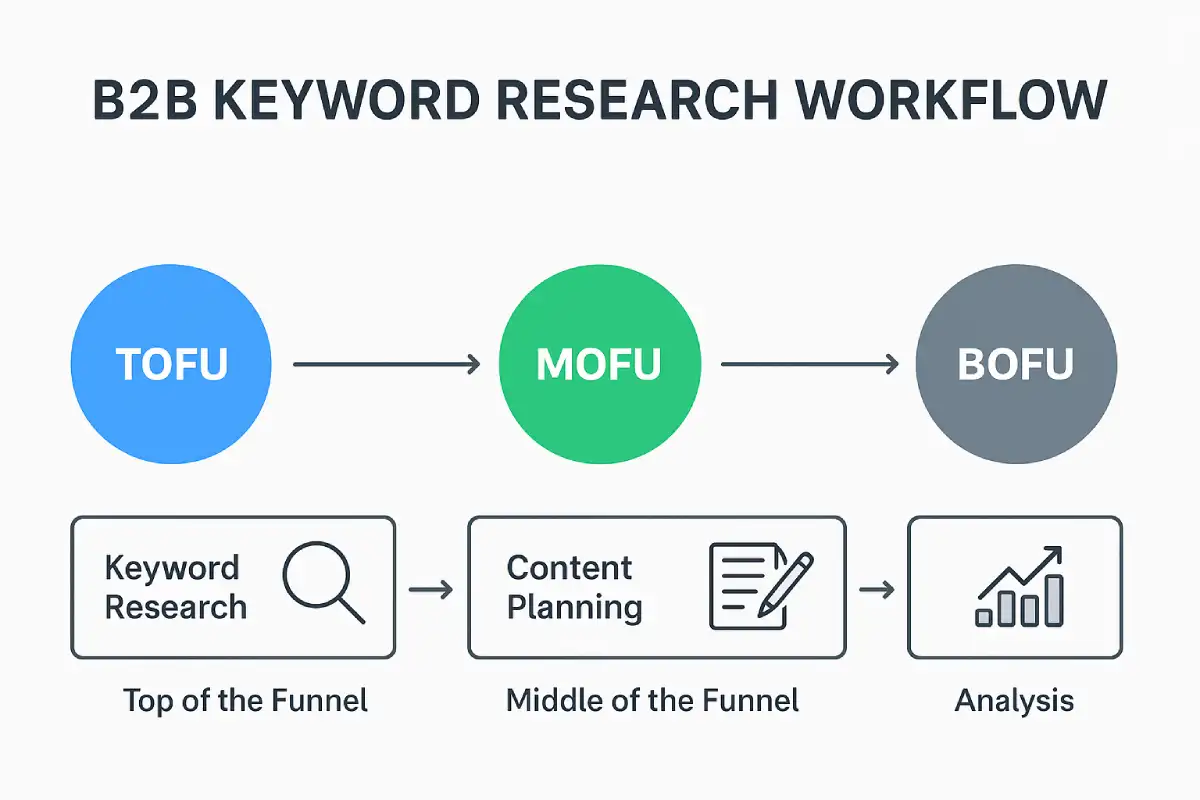
2. Why the B2B Buyer Journey Completely Changes Keyword Selection
B2B buyers don’t search randomly.
They move through clear stages, and each stage demands different keywords.
2.1 Top-of-Funnel Keywords (Problem Awareness)
These users want education, not sales.
Examples:
- what is B2B lead nurturing
- how to improve sales pipeline efficiency
- common CRM challenges for SaaS
2.2 Middle-of-Funnel Keywords (Solution Comparison)
Buyers start evaluating options.
Examples:
- best B2B CRM software
- HubSpot vs Salesforce for SaaS
- email marketing tools for B2B companies
2.3 Bottom-of-Funnel Keywords (Purchase Intent)
This is where conversions happen.
Examples:
- CRM onboarding consultant
- best CRM for B2B SaaS startups
- enterprise marketing automation pricing
Skipping any stage breaks your funnel — and your SEO ROI.
3. Step-by-Step Framework to Find High-Intent B2B Keywords
3.1 Step 1: Extract Keywords from Sales & Customer Conversations
Your sales team is your most powerful keyword tool.
Ask them:
- What questions do prospects ask before buying?
- What objections delay deals?
- What words do leads use to describe their problems?
Also interview customers:
- What did you search before choosing us?
- What alternatives did you compare?
- What problem pushed you to act?
These phrases often never appear in keyword tools — but convert best.
3.2 Step 2: Expand Keywords Using SEO Research Tools
Once you have seed keywords, expand intelligently.
Use tools like:
- Keyword suggestion platforms
- Question-based keyword tools
- SERP analysis tools
Focus on:
- Long-tail keywords
- Commercial modifiers (best, vs, alternatives)
- CPC indicators (high CPC = buyer value)
👉 “Free Keyword Research Tool” on seotoolking.com
3.3 Step 3: Competitor Keyword Gap Analysis for B2B Niches
Instead of copying competitors, outperform them.
Look for:
- Keywords they rank for but don’t fully answer
- Shallow content you can expand
- Missing use-case or industry-specific angles
In B2B SEO, depth beats breadth every time.
3.4 Step 4: Analyze Search Intent Before Volume
High volume ≠ high value.
Low-Intent Example:
- lead generation
High-Intent Example:
- lead generation software for SaaS startups
Always prioritize:
- Relevance
- Buyer readiness
- Specificity
3.5 Step 5: Build Keyword Pillars and Topic Clusters
Organize keywords into content ecosystems, not random posts.
Example:
Pillar Page:
B2B Email Marketing Software
Supporting Clusters:
- email automation for B2B
- lead nurturing workflows
- B2B email personalization strategies
This structure:
- Improves rankings
- Builds topical authority
- Guides buyers toward conversion
4. 4 High-Converting B2B Keyword Types You Should Focus On
4.1 Comparison Keywords (Decision-Stage Power)
Examples:
- tool A vs tool B
- SOC 2 vs ISO 27001
These keywords signal active evaluation.
4.2 Integration Keywords (High Technical Intent)
Examples:
- CRM with QuickBooks integration
- Slack integration for project management
These users are close to buying.
4.3 Use-Case Keywords (Precision Targeting)
Examples:
- CRM for B2B SaaS startups
- marketing automation for agencies
Specificity = higher conversion rate.
4.4 Pain-Point Keywords (Problem-Driven Search)
Examples:
- why B2B leads don’t convert
- how to reduce churn in SaaS
These keywords build trust early.
5. What to Do After Keyword Research: Turn SEO into Revenue
Once keywords are selected, activate them:
- Optimize titles, headings, and meta descriptions
- Add FAQ schema and structured data
- Build internal links to content hubs
- Repurpose keywords into videos and slides
- Optimize for AI search and LLM visibility
👉 “On-Page SEO meta tag Checklist” on seotoolking.com
FAQs: B2B Keyword Research & SEO
Does SEO work for B2B companies?
Yes. B2B SEO drives long-term visibility, qualified leads, and trust across the buyer journey.
Why are long-tail keywords important in B2B SEO?
They attract decision-makers who know their problem and are closer to purchasing.
How often should B2B keyword research be updated?
Every 3–6 months, or when your product, market, or competitors change.
Can small B2B businesses compete with big brands in SEO?
Yes. Niche targeting, long-tail keywords, and content depth level the playing field.
Final Conclusion: Build Authority, Not Just Rankings
B2B keyword research isn’t about traffic — it’s about trust, timing, and relevance.
When you understand:
- Who your buyers are
- What they search at each stage
- Why they choose one solution over another
You stop guessing — and start converting.
Use this strategy to position seotoolking.com as a trusted authority, not just another website chasing keywords.
Related Articles