Key Takeaways
- Google’s AI Revolution Has Officially BegunGoogle I/O 2026 and Google Marketing Live 2026 may become two of the most important technology and marketing events in recent history.
- Because Google made one thing extremely clear:The future of the internet will be powered by AI.
- For decades, the internet worked in a predictable way:Users searched keywordsGoogle displayed linksUsers visited websitesBusinesses competed for clicksThat system created the modern SEO industry.
- Instead of acting only as a search engine, Google is evolving into an AI-powered assistant capable of:Answering questions directlyComparing productsSummarizing informationRecommending solutionsHelping users make decisionsCompleting tasks automaticallyThis shift affects nearly every part of digital marketing, including:SEOContent marketingGoogle AdsE-commerceAffiliate marketingYouTube marketingBrand buildingAnalyticsCustomer journeysBusinesses that understand these changes early may gain a massive competitive advantage over the next several years.
- The Big Shift: Google I/O 2026 AI and Marketing Live ChangesEvery year, Google hosts two major global events that shape the future of technology and digital marketing.
- Google I/O 2026Google I/O is Google’s biggest technology conference.
Google’s AI Revolution Has Officially Begun
Google I/O 2026 and Google Marketing Live 2026 may become two of the most important technology and marketing events in recent history.
Why?
Because Google made one thing extremely clear:
The future of the internet will be powered by AI.
For decades, the internet worked in a predictable way:
- Users searched keywords
- Google displayed links
- Users visited websites
- Businesses competed for clicks
That system created the modern SEO industry.
But now Google is changing the rules.
Instead of acting only as a search engine, Google is evolving into an AI-powered assistant capable of:
- Answering questions directly
- Comparing products
- Summarizing information
- Recommending solutions
- Helping users make decisions
- Completing tasks automatically
This shift affects nearly every part of digital marketing, including:
- SEO
- Content marketing
- Google Ads
- E-commerce
- Affiliate marketing
- YouTube marketing
- Brand building
- Analytics
- Customer journeys
Businesses that understand these changes early may gain a massive competitive advantage over the next several years.
The Big Shift: Google I/O 2026 AI and Marketing Live Changes
Every year, Google hosts two major global events that shape the future of technology and digital marketing.
Google I/O 2026
Google I/O is Google’s biggest technology conference.
It focuses on:
- Artificial intelligence
- Search innovations
- Android updates
- Gemini AI
- Developer tools
- Future hardware
- Productivity tools
- AI assistants
- Wearable technology
Google I/O usually reveals where technology is heading.
Google Marketing Live 2026
Google Marketing Live focuses on advertising and business growth.
Topics include:
- Google Ads
- AI-powered campaigns
- YouTube advertising
- Analytics
- Measurement tools
- Shopping experiences
- Performance marketing
- Automation
- Commerce solutions
Historically, these events felt separate.
Google I/O focused on consumers and technology.
Google Marketing Live focused on advertisers and businesses.
But in 2026, both events clearly connected into one unified vision:
Google wants AI to become the center of the entire internet experience.
Google Search Is No Longer Just a Search Engine
One of the biggest announcements from Google I/O 2026 was the transformation of Google Search itself.
For over 20 years, Search worked in a relatively simple way:
Users typed keywords → Google displayed links → websites competed for clicks.
Now Google is introducing a much more conversational and intelligent experience powered by AI.
Instead of simply helping users find websites, Google increasingly wants to help users complete decisions directly inside Search.
This is a massive shift.
Search Is Becoming a Decision Engine
Google’s AI systems are now designed to:
- Understand complex questions
- Analyze intent
- Summarize information
- Compare products
- Recommend solutions
- Continue conversations
- Help users take action
This means Search is evolving from:
“Find information”
to:
“Help users make decisions.”
That changes everything about SEO and digital marketing.
As showcased throughout the Google I/O 2026 AI keynotes, search engine systems are no longer just indexing links—they are thinking dynamically.
What Are AI Overviews?
AI Overviews are AI-generated summaries displayed directly inside Google Search results.
Instead of showing only traditional blue links, Google now combines information from multiple sources into one AI-generated answer.
Example of AI Overviews
Imagine someone searches:
“Best laptop for video editing under $1500”
Previously, Google displayed:
- Blog articles
- Product review websites
- YouTube videos
- E-commerce stores
- Forums
Users had to manually compare products.
Now Google AI may instantly provide:
- Recommended laptops
- Performance comparisons
- Battery life analysis
- Pros and cons
- User ratings
- Buying recommendations
- Price comparisons
All directly inside Search.
In many cases, users may not even need to visit websites.
That creates a completely different internet experience.
Why AI Overviews Matter for SEO
This update could dramatically reshape organic traffic.
For years, SEO focused heavily on rankings and clicks.
Traditional SEO Model
- Rank for keywords
- Get clicks
- Drive traffic
- Convert visitors
AI Search Model
- AI summarizes information
- Users receive answers instantly
- Fewer clicks may happen
- Brand authority becomes critical
This means:
- Organic click-through rates may decline
- Informational traffic may decrease
- AI visibility becomes essential
- Brand trust becomes more valuable
Example: Traditional SEO vs AI SEO
Traditional SEO
You rank #1 for:
“Best CRM software”
Thousands of users click your article.
AI Search SEO
Google AI directly recommends:
with summaries, comparisons, and reviews.
If your brand lacks authority, AI may never mention your business at all.
That is why trust and authority are becoming central to future SEO success.
Gemini AI Is Becoming Google’s Intelligence Layer
Another major focus at Google I/O 2026 was Gemini AI.
Google no longer presents Gemini as simply a chatbot competitor.
Instead, Gemini is becoming the intelligence layer powering Google’s entire ecosystem.
Where Gemini AI Will Be Integrated
Gemini is being integrated into:
- Google Search
- Android
- Chrome
- Google Workspace
- Gmail
- YouTube
- Shopping
- Google Ads
- Wearable devices
- Developer tools
Google wants Gemini to become a universal AI assistant capable of helping users throughout their daily lives.
What Gemini AI Can Do
Gemini AI is designed to:
- Research information
- Compare products
- Summarize documents
- Organize workflows
- Recommend actions
- Assist with shopping
- Generate content
- Analyze data
- Complete tasks automatically
This moves AI beyond simple chat interactions.
Example of Gemini AI in Real Life
Imagine asking:
“What’s the best DSLR camera for beginners under $1000?”
Gemini AI may:
- Compare camera models
- Analyze expert reviews
- Explain technical differences
- Recommend the best option
- Suggest accessories
- Show nearby stores
- Compare prices
- Help complete the purchase
Instead of manually researching across multiple websites, AI handles much of the process automatically.
AI Agents Could Change the Entire Internet
One of the most important long-term trends is the rise of AI agents.
AI agents are systems capable of performing tasks on behalf of users.
Instead of simply answering questions, future AI systems may:
- Book appointments
- Compare insurance plans
- Purchase products
- Schedule meetings
- Research travel options
- Manage workflows
This creates a future where users spend less time browsing manually.
Instead, AI may browse for them.
The Future of SEO May Depend on AI Trust
In the future, businesses may not compete only for rankings.
They may compete for AI recommendations.
The real question becomes:
“Does Google AI trust your brand?”
AI systems are more likely to recommend businesses that demonstrate:
- Expertise
- Authority
- Trustworthiness
- Positive reviews
- Strong backlinks
- Brand mentions
- Helpful content
- Consistent reputation
This aligns closely with Google’s EEAT principles:
- Experience
- Expertise
- Authoritativeness
- Trustworthiness
Why Brand Authority Is Becoming Critical
Strong brands naturally generate signals AI systems trust.
These signals include:
- Reviews
- Mentions
- Citations
- Backlinks
- Social engagement
- Search demand
- User satisfaction
AI systems use these signals to determine credibility.
That means future SEO success may depend heavily on brand strength.
Google Ads Is Becoming Fully AI-Powered
Google Marketing Live 2026 revealed major changes to Google Ads.
Google is rapidly moving toward an AI-driven advertising ecosystem.
Instead of manually controlling every campaign detail, advertisers increasingly provide goals while AI handles execution.
Google’s New Advertising Philosophy
The future advertising workflow looks like this:
Advertiser sets goals → AI handles optimization
Businesses define objectives such as:
- More leads
- More sales
- More subscriptions
- Higher ROI
Then AI automatically manages:
- Targeting
- Budget allocation
- Creative testing
- Audience optimization
- Bid adjustments
- Performance improvements
New AI Advertising Tools Announced
Google introduced several powerful AI tools.
Ask Advisor
Ask Advisor acts like an AI marketing consultant.
It helps advertisers:
- Improve campaigns
- Analyze performance
- Suggest optimizations
- Identify opportunities
- Improve ROI
- Understand analytics
This reduces the complexity of campaign management.
Asset Studio
Asset Studio uses AI to generate marketing assets automatically.
It can create:
- Ad creatives
- Headlines
- Product images
- Video assets
- Display banners
- Marketing visuals
This dramatically speeds up content production.
Example of AI Advertising Automation
Previously, advertisers needed to:
- Design creatives manually
- Write ad copy
- Test audiences
- Optimize bids
- Analyze reports
Now AI can automatically:
- Generate multiple ad versions
- Test headlines
- Optimize targeting
- Allocate budgets
- Improve conversions
- Scale winning campaigns
within minutes.
This changes the role of marketers from operators to strategists.
Keyword-Based Marketing Is Becoming Less Important
One of the clearest themes from Google Marketing Live was the decline of exact-match keyword dependency.
Google’s AI systems are becoming much better at understanding intent.
Example of Search Intent Evolution
Old Search Query
“Best gaming phone under $500”
New Conversational Search
“I want a phone with strong gaming performance, long battery life, and a good camera under $500.”
Google AI understands the meaning even without exact keywords.
This means future SEO will rely more on:
- User intent
- Topic authority
- Context
- Natural language
- Helpful content
- Semantic relevance
rather than keyword stuffing.
Conversational Search Is Changing User Behavior
Users are increasingly interacting with Search like a conversation.
Instead of typing short keywords, people now ask:
- Detailed questions
- Follow-up questions
- Personalized requests
- Contextual queries
This creates a more natural search experience.
Businesses must adapt content strategies accordingly.
YouTube Is Becoming More Important Than Ever
Google also emphasized YouTube’s growing role in the customer journey.
YouTube is no longer just a brand awareness platform.
It is becoming a major driver of:
- Product discovery
- Consumer trust
- Purchase decisions
- AI recommendations
- Shopping behavior
Why YouTube Matters More in the AI Era
As AI reduces website clicks, video content may become even more influential.
Consumers increasingly trust:
- Product reviews
- Tutorials
- Creator recommendations
- Comparison videos
- Demonstrations
before making purchases.
Example
Before buying a smartphone, users may watch:
- Unboxing videos
- Camera tests
- Gaming performance reviews
- Battery comparisons
- Long-term usage reviews
This creates stronger trust than traditional text content alone.
Conversational Commerce Is the Future of Shopping
Another major trend announced by Google is conversational commerce.
Instead of manually browsing stores, users may increasingly ask AI for shopping recommendations.
Example of Conversational Shopping
A user asks:
“What’s the best protein powder for muscle gain?”
AI may instantly provide:
- Recommended brands
- Ingredient analysis
- Nutrition comparisons
- Reviews
- Price comparisons
- Purchase links
without requiring extensive manual research.
The Customer Journey Is Changing
Traditional customer journeys involved multiple steps.
Traditional Funnel
Search → Website → Research → Cart → Purchase
AI-Powered Funnel
Ask AI → Receive Recommendation → Buy
This shorter journey could dramatically reshape e-commerce and digital marketing.
Measurement and Analytics Are Becoming More Important
As automation increases, data quality becomes even more valuable.
Businesses with strong analytics systems may outperform competitors.
Why First-Party Data Matters
Google emphasized the importance of:
- Clean customer data
- Accurate conversion tracking
- Better attribution
- Measurement discipline
- Incrementality testing
AI systems perform better when they receive better data.
Example
Two businesses may use the same AI advertising tools.
But the company with:
- Better analytics
- Cleaner customer data
- Stronger conversion tracking
will likely achieve better results.
Why Brand Authority Matters More Than Ever
One of the biggest lessons from Google’s announcements is this:
Strong brands will dominate AI-driven search.
AI systems naturally prefer recognizable and trusted brands.
Why AI Prefers Strong Brands
Strong brands usually have:
- Better reviews
- More backlinks
- Higher engagement
- More mentions online
- Greater search demand
- Stronger reputation
AI systems interpret these signals as indicators of trustworthiness.
Example
If someone asks AI:
“What’s the best SEO tool for beginners?”
AI is more likely to recommend:
- Trusted brands
- Popular platforms
- Highly reviewed tools
- Authoritative websites
This is why brand building is becoming one of the most important SEO strategies.
What This Means for seotoolking.com
For websites like seotoolking.com, the opportunity is enormous.
The future belongs to websites that provide:
- Helpful tutorials
- Expert insights
- Real-world examples
- AI-friendly content
- Strong branding
- User trust
- Educational resources
Websites that genuinely help users may perform better in AI-powered search environments.
Future SEO Strategy for 2026 and Beyond
1. Focus on Helpful Content
Create content that solves real user problems.
Avoid thin or low-value articles.
2. Build Topic Authority
Cover your niche deeply and consistently.
Become a trusted source in your industry.
3. Optimize for AI Readability
Use:
- Clear headings
- Structured formatting
- FAQs
- Tables
- Bullet points
- Examples
This helps AI systems understand your content better.
4. Build a Recognizable Brand
Brand trust may directly influence AI recommendations.
Invest in reputation and authority.
5. Invest in Video Content
YouTube and video marketing will likely become even more important.
6. Improve First-Party Data
Better analytics and measurement create competitive advantages.
7. Focus on EEAT
Demonstrate:
- Experience
- Expertise
- Authority
- Trustworthiness
across all content.
8. Create Multi-Format Content
Future SEO may reward brands that publish:
- Articles
- Videos
- Podcasts
- Infographics
- Interactive tools
across multiple platforms.
Final Thoughts
Google I/O and Google Marketing Live 2026 showed that AI is no longer an experimental technology.
It is becoming the foundation of:
- Search
- Advertising
- Shopping
- SEO
- Content discovery
- Productivity
- Online decision-making
The future internet will revolve around AI-assisted answers, recommendations, and automated experiences.
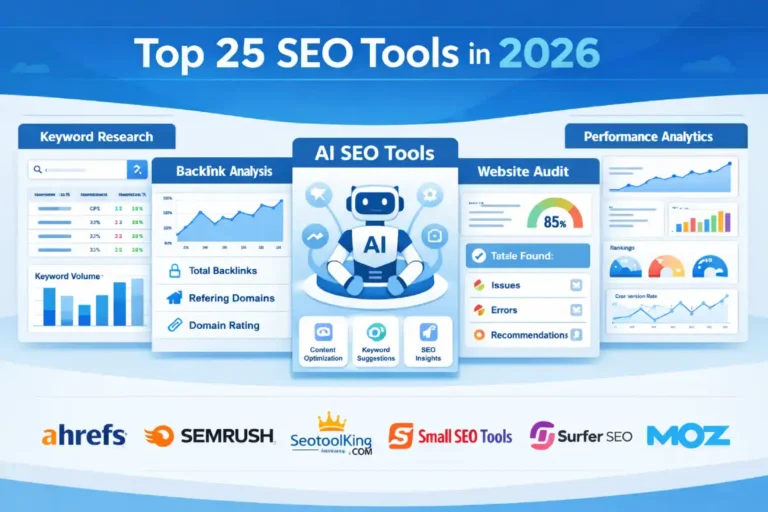
Read this : 25 Best SEO Tools I’m Using in 2026 (Free + Paid)
Businesses that rely only on outdated SEO tactics may struggle.
The companies that succeed will likely focus on:
- Trust
- Authority
- Expertise
- Brand recognition
- Helpful content
- Strong user experiences
In the AI era, authority may become the new distribution channel.
And that could completely redefine digital marketing over the next decade.
Google I/O 2026, Google Marketing Live 2026, Gemini AI, AI Search Google, Future of SEO, Google Ads AI, AI Overviews, Conversational Search, AI-powered marketing, SEO trends 2026, Future of Google Search, AI in digital marketing, AI commerce, Google AI updates
Frequently Asked Questions (FAQs)
What is Google AI Overviews?
AI Overviews are AI-generated summaries shown directly in Google Search results that provide quick answers without requiring users to visit multiple websites.
How will AI affect SEO?
AI will shift SEO away from pure keyword optimization toward authority, trust, user intent, and high-quality helpful content.
What is Gemini AI?
Gemini is Google’s advanced AI system integrated across Search, Android, Workspace, YouTube, Google Ads, and other Google products.
Will website traffic decrease because of AI Search?
Some informational traffic may decline because users can receive answers directly in Search. However, authoritative brands may still benefit significantly.
Is keyword SEO dead?
No. Keywords still matter, but Google increasingly relies on conversational understanding, context, and user intent.
Why is brand authority important for AI SEO?
AI systems are more likely to recommend brands that appear trustworthy, authoritative, and widely recognized online.
What is conversational commerce?
Conversational commerce refers to AI-powered shopping experiences where users ask questions naturally and receive personalized product recommendations.
How can businesses prepare for AI-powered search?
Businesses should focus on:
Helpful content
Brand authority
EEAT
Video marketing
Structured content
Better analytics
User trust
Related Articles